What the PCOS to PMOS Name Change Actually Means for You
If you've been living with PCOS for any length of time, you've probably already seen the headlines. The condition you've known your whole life by one name has just been officially renamed and the internet is buzzing.
But beneath the noise, you might be wondering: does this actually change anything for me?
The short answer is yes - more than you might think. Not in terms of your symptoms, your treatment, or your day-to-day management. But in terms of how this condition is understood, diagnosed, taken seriously, and treated by the medical system - this is genuinely significant.
Let me break it down clearly!
What has actually changed?
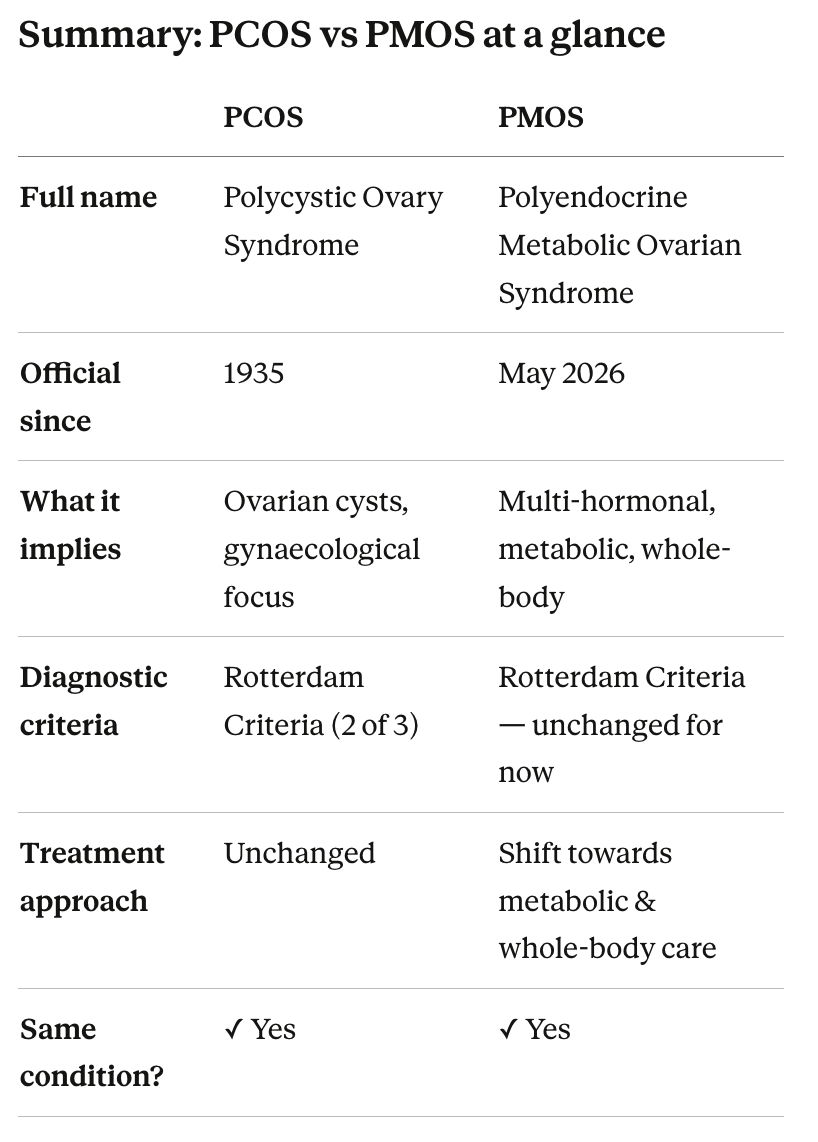
As of 12 May 2026, polycystic ovary syndrome PCOS has been officially renamed Polyendocrine Metabolic Ovarian Syndrome, or PMOS.
The name change was published in The Lancet - one of the most respected medical journals in the world - and is the result of an unprecedented global consensus process involving 56 leading academic, clinical, and patient organisations, along with survey responses from over 22,000 people - patients, doctors, researchers, and advocates from every region of the world.
This didn't happen overnight. It was the result of more than a decade of advocacy, research, and rigorous debate. The process was led by Professor Helena Teede, an endocrinologist and professor of Women's Health at Monash University in Australia and it represents one of the most extensive disease-renaming processes in medical history.
Why did the name need to change?
To understand why this matters, you have to understand why the old name was always a problem.
"Polycystic ovary syndrome" was misleading in almost every way.
First the cysts. As many of you already know, the "cysts" in PCOS are not actually cysts. They are immature follicles. Eggs that haven't fully developed because of hormonal disruption. Calling them cysts implied something pathological happening in the ovaries, when in reality the ovaries are not the primary driver of this condition at all.
Second the framing. Calling it a "syndrome" of the "ovaries" implied this was primarily a gynaecological condition. Something about periods and fertility. Something women's health departments dealt with. In reality, PCOS is a complex, multi-system, endocrine and metabolic disorder that affects the heart, the gut, the brain, the skin, the metabolism, and long-term disease risk far beyond reproductive health.
This framing had real consequences. It contributed to:
Diagnostic delays - up to 70% of women with PCOS remain undiagnosed, partly because the name doesn't reflect the breadth of the condition
Fragmented care - women being bounced between dermatologists for their acne, endocrinologists for their insulin, gynaecologists for their periods, and psychiatrists for their anxiety - with no one connecting the dots
Stigma - particularly around weight, with many women being told to simply "lose weight" rather than being offered the investigation and support they deserved
Missed research and funding - because a condition framed as primarily gynaecological attracted less cardiometabolic and metabolic research funding than it warranted
The name wasn't just inaccurate. It was actively getting in the way of good care.
So what does PMOS actually stand for and why is it better?
P - Polyendocrine "Poly" meaning many, "endocrine" meaning hormonal. This word acknowledges that PMOS involves multiple interacting hormonal disturbances. Not just androgens, but insulin, cortisol, neuroendocrine hormones, and more. It reflects the reality that this is a condition of the entire endocrine system, not just the ovaries.
M - Metabolic This is perhaps the most important addition. The word "metabolic" formally acknowledges what researchers and practitioners have known for years. That insulin resistance and metabolic dysfunction are at the core of most PMOS cases. This opens the door to better metabolic treatment, more appropriate research funding, and clearer pathways for clinical care.
O - Ovarian The ovaries are still named, because they remain involved in the condition. Particularly in terms of androgen production and the follicular development disruption we see on ultrasound.
S - Syndrome A syndrome is a collection of signs and symptoms that tend to occur together. This part stays, because PMOS presents differently in different people. It is not a single disease with one cause, but a spectrum of presentations with shared underlying mechanisms.
Together, the name PMOS paints a far more accurate picture: a condition involving multiple hormones, deeply rooted in metabolic dysfunction, with ovarian involvement as one part of a much bigger picture.
What does this mean for diagnosis?
In terms of the diagnostic criteria themselves, nothing changes immediately. The Rotterdam Criteria needing 2 out of 3 of irregular periods, signs of elevated androgens, and polycystic ovarian morphology on ultrasound remain in place for now.
However, the name change is accompanied by updates to clinical guidelines, medical education, and international disease classification systems. Over time, this is expected to lead to:
Earlier and more accurate diagnosis - because clinicians will be educated to look for metabolic and endocrine features, not just ovarian ones
Better blood test ordering - fasting insulin, HOMA-IR, and metabolic markers being ordered routinely alongside hormone panels
More holistic care - endocrinologists, cardiologists, dietitians, and mental health professionals being brought into PMOS care from the beginning
Reduced diagnostic delay - as the broader symptom picture becomes better recognised across specialties
There is a three-year transition period during which both PCOS and PMOS will be used interchangeably across medical education and clinical practice. So don't be alarmed if your GP still says PCOS.
What does this mean for treatment?
Again your treatment plan doesn't suddenly change on the basis of a name. What you were doing before still applies.
But what the name change signals is a shift in how this condition should be treated going forward:
More focus on metabolic health. With "metabolic" in the name, there is now formal clinical acknowledgement that blood sugar, insulin resistance, cardiovascular risk, and gut health are central to PMOS management - not peripheral concerns. This means nutrition, movement, and lifestyle medicine should be front and centre of your care, not afterthoughts.
Less dismissal around weight. The metabolic framing helps shift the narrative away from "just lose weight" and towards understanding why metabolic changes occur in PMOS, and addressing the root cause rather than the symptom.
More joined-up care. Rather than being seen by only a gynaecologist, women with PMOS should increasingly be supported by a team - dietitian’s, endocrinologists, mental health professionals, and GPs working together. The name signals this is warranted.
More research funding. Conditions framed as metabolic and endocrine attract significantly more research investment than those framed as purely gynaecological. This name change could unlock funding that leads to better treatments, earlier detection tools, and potentially a clearer understanding of the root causes of PMOS over the coming decade.
What does this mean practically for you?
Here's the honest truth: in your day-to-day life, very little changes immediately. Your symptoms are the same. Your body is the same. The foods that support your hormones, the movement that helps your insulin sensitivity, the supplements that make a difference - none of that changes.
What does change is this:
You now have language that better reflects your experience. So many women with PCOS have spent years being told their condition was "just" about their periods or their fertility. PMOS says: no. This is a whole-body, multi-system hormonal and metabolic condition. And that framing matters for how you advocate for yourself.
You can use this moment to go back to your doctor. If you've been managing PCOS without a fasting insulin test, without a full metabolic panel, without discussion of gut health or cardiovascular risk - now is a very good time to revisit your care. Bring this information with you. Ask for the full picture.
You can let go of the guilt around the "cyst" narrative. The name change formally removes the cyst framing from the condition. If you've ever felt confused or dismissed because "the ultrasound didn't show cysts". This name change validates what you already knew. Cysts were never the point.
A note from me
When I first heard about the name change, my instinct was to feel a little emotional about it and I want to be honest about that.
I've spent years explaining to people that PCOS isn't just about cysts. That it's metabolic. That it affects my gut, my energy, my mood, my skin, and my relationship with food. That it required an overhaul of how I ate, how I moved, how I slept, and how I managed stress. That becoming a Pilates instructor ans nutrition stunednt wasn't a career change it was part of how I healed.
Having the medical community formally validate that with a new name that says metabolic, polyendocrine, multi-system that means something. Not because I needed the validation. But because the women who come after us deserve to be taken seriously from the very first appointment.
If this name change means even one woman gets her fasting insulin tested, or gets referred to a dietitian, or doesn't get told to "just lose weight" - then a decade of advocacy was worth it.
What should you do with this information?
1. Don't panic about the name change. Your diagnosis is still valid. Your experience is still real. PCOS and PMOS are the same condition. One name is just far more accurate than the other.
2. Use it as a conversation opener with your doctor. If you haven't had a full metabolic workup - fasting insulin, HbA1c, lipid panel, thyroid - now is a great time to ask. Point to the name change as a reason to revisit your care comprehensively.
3. Embrace the metabolic framing. The most effective things you can do for PMOS are the same things that support metabolic health: balancing blood sugar, building muscle, healing your gut, managing stress, and sleeping well. The science was always there the name is now catching up.
4. Be patient with the transition. Most GPs, specialists, and the general public will still say PCOS for the foreseeable future. The three-year transition period is there for a reason. You don't need to correct everyone just know that both terms refer to the same condition.
5. Keep going. Whatever you were doing to manage your PCOS it still applies. This is not a reset. It is a recognition.
Your next steps
→ New to this? Start with the basics If you've just been diagnosed or you suspect you might have PMOS read my post: Think You Might Have PCOS (now called PMOS)? Start Here. It covers everything from symptoms to lab tests to where to begin.
↓ Download the free PMOS Starter Guide Workbook A complete, practical workbook covering symptoms, nutrition, gut health, movement, sleep, stress, lab tests, goal setting, and tracking - all in one place. Free to download. (Coming Soon)
→ Explore the blog Nutrition, gut health, movement, recipes, and the honest reality of living well with PMOS - all here.
→ Follow along on Instagram I'll be sharing more about what the name change means, how it affects the community, and how we move forward together!
