The New Food Pyramid: What Changed, What's Controversial, and What It Actually Means for PCOS
If you've been following health news lately, you've probably seen the headlines about America's dramatically overhauled dietary guidelines and the completely flipped food pyramid that came with them. And if you're feeling confused about what it all means particularly for your PCOS management you're not alone.
In January 2026, the US released what Health Secretary Robert F. Kennedy Jr. described as the most significant reset of federal nutrition policy in decades. The traditional food pyramid has been literally turned upside down. And the recommendations inside have nutrition scientists, Harvard researchers, and public health experts deeply divided.
So what actually changed? Why is everyone arguing about it? And most importantly what does any of this mean for those of us managing PCOS in Australia?
Let's break it down.
What Actually Changed: The Upside-Down Pyramid
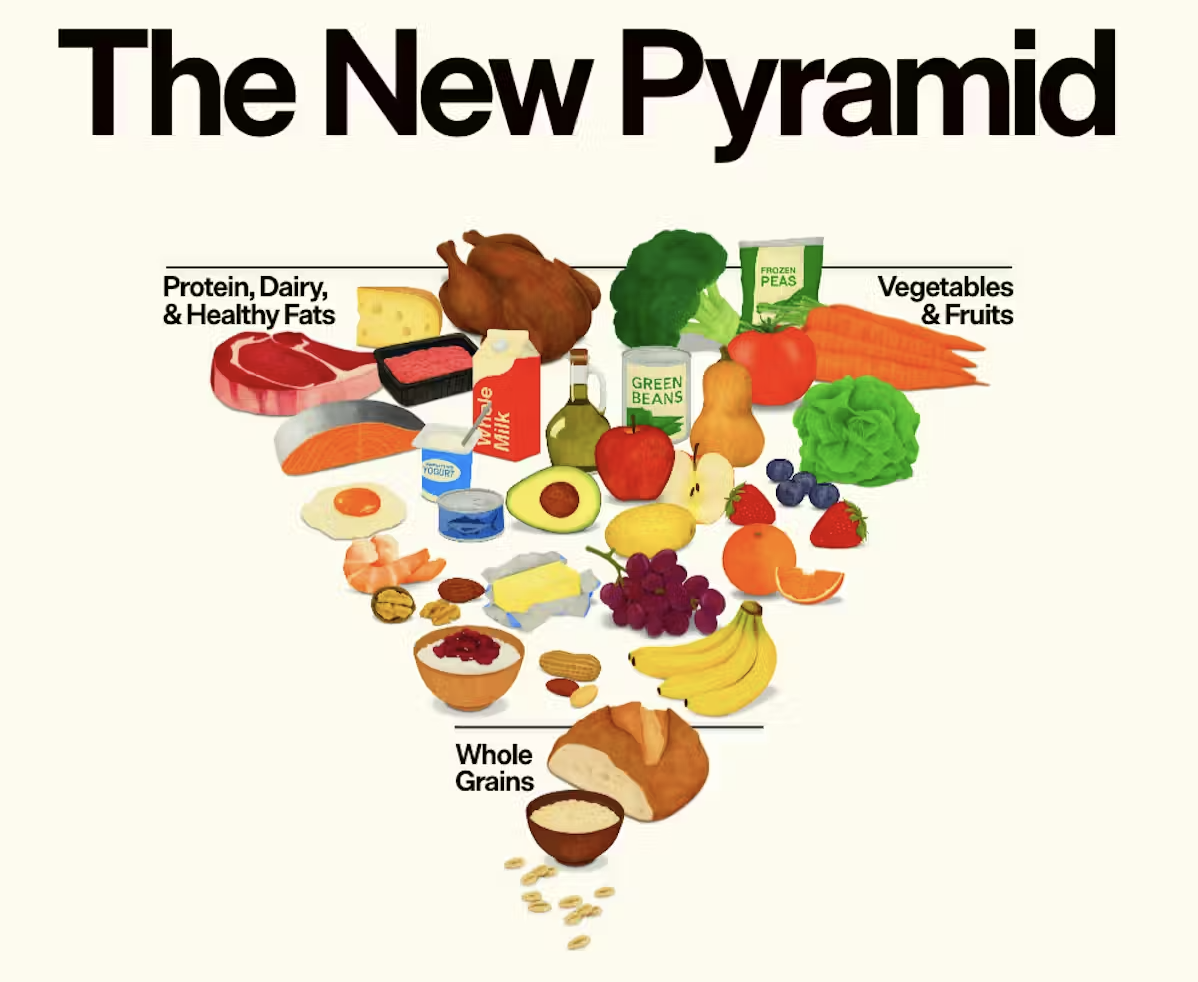
The 2025–2030 Dietary Guidelines for Americans were released alongside a reimagined, inverted food pyramid. At the top - the largest section - are protein, dairy, and healthy fats, placed alongside vegetables and fruits, both given equal importance. Whole grains sit at the narrow bottom, the smallest section of the pyramid.
The visual message is clear: prioritise protein and healthy fats, eat plenty of vegetables and fruits, and limit your grain intake to whole grains only.
The guidelines call for prioritising high-quality, nutrient-dense protein foods at every meal, with a particular focus on animal sources. They also advocate receiving the bulk of fat from whole food sources such as meats, poultry, eggs, omega-3-rich seafood, nuts, seeds, full-fat dairy, olives, and avocados.
For the first time, the guidelines explicitly call out ultra-processed foods as problematic, advising Americans to "avoid highly processed packaged, prepared, ready-to-eat, or other foods that are salty or sweet" and to "avoid sugar-sweetened beverages." On added sugars, the stance is unambiguous: no amount is recommended or considered part of a healthy diet, and for children aged four and under, complete avoidance is advised
The Controversy: Where Science and Politics Collide
Here's where things get genuinely complicated and why applying critical thinking to these guidelines matters before changing how you eat.
The scientific advisory committee's report, produced after two years of rigorous evidence review, was ultimately rejected by the current administration. A supplemental scientific analysis was then conducted by a separately selected group, raising concerns about transparency and process.
Three Harvard nutrition faculty members served on the original advisory committee. According to Deirdre Tobias, assistant professor in the Department of Nutrition at Harvard, while the quantitative recommendations are largely consistent with previous guidelines, "the biggest deviation from the science is a new prioritisation of animal sources within the protein food group, instead of a plant-forward pattern." She also flagged concerns about the full-fatdairy recommendation and noted that vegetable oils - primary sources of essential unsaturated fatty acids - were "notably absent from being listed among healthy oils."
Christopher Gardner, a nutrition expert at Stanford University who also served on the advisory committee, expressed clear disappointment: "I'm very disappointed in the new pyramid that features red meat and saturated fat sources at the very top, as if that's something to prioritise. It does go against decades and decades of evidence and research."
The American Society for Nutrition raised concerns that the work of the Dietary Guidelines Advisory Committee was abandoned, "departing from the established scientific review process" in a way that will "undermine confidence in the guidelines." The Academy of Nutrition and Dietetics said some recommendations are "not aligned with the current body of evidence."
One of the most technically confusing aspects is the guidelines retain the longstanding limit that saturated fat should not exceed 10% of total daily calories while simultaneously featuring steak, cheese, whole milk, and butter prominently in the pyramid's largest section. Reconciling those two messages in practice is genuinely difficult. The Nutrition Source
This isn't to say the guidelines are entirely without merit. The hard line on ultra-processed foods and added sugar represents a meaningful, evidence-supported shift. But the political context matters: these guidelines were released under the Trump administration and shaped by a process that departed significantly from the established scientific review that previous editions followed.
What About Australian Guidelines?
Before you overhaul your PCOS nutrition based on an American food pyramid, here's what's relevant for us here.
Australia's current dietary guidelines, developed by the National Health and Medical Research Council (NHMRC), are from 2013. The NHMRC is currently undertaking a review, with updated guidelines scheduled for delivery in 2026. Until then, Australians are advised to follow the 2013 recommendations.
The current Australian Dietary Guidelines recommend enjoying a wide variety of nutritious foods from the five food groups every day - vegetables and legumes, fruit, grain foods (mostly whole grain), lean meats and poultry, fish, eggs, tofu, nuts and seeds, and dairy or alternatives. While limiting intake of foods containing saturated fat, added salt, added sugars, and alcohol.
The Australian guidelines currently maintain a more plant-inclusive, evidence-based framework that aligns more closely with decades of global nutrition research including the Mediterranean dietary pattern, which has among the strongest evidence for long-term health outcomes of any eating pattern studied. The upcoming 2026 revision is being developed through a transparent expert committee process with public consultation. A meaningful contrast to the political circumstances surrounding the new US guidelines.
What This Means Specifically for PCOS
Whether you're following Australian or US guidelines, the PCOS-specific nutritional picture requires additional nuance. Here's how to interpret the key changes through a hormonal health lens.
On the "eat real food" message absolutely yes.
This is the aspect of the new guidelines with the strongest evidence behind it and the most direct relevance to PCOS. Ultra-processed foods drive insulin resistance, worsen gut dysbiosis, increase systemic inflammation, and promote the androgenic and metabolic features of PCOS. Prioritising whole, minimally processed foods is not a trend it's one of the most evidence-supported dietary strategies available for managing the condition. On this point, the new guidelines and the PCOS research literature are in complete agreement.
On reducing added sugar - strongly supported for PCOS.
Insulin resistance is present in up to 70% of women with PCOS, and added sugar is one of the most direct dietary drivers of insulin spikes and insulin resistance. The hard line on added sugar, particularly in beverages, is well-supported by research and particularly meaningful for PCOS management.
On protein helpful context, with caveats.
Adequate protein at each meal is genuinely beneficial for PCOS. It moderates the blood sugar response, supports satiety, and helps reduce the insulin spikes that worsen hormonal dysregulation. But the source matters. Harvard's Edward Giovannucci noted that a large body of evidence supports greater emphasis on polyunsaturated fats, which come mostly from plant-based foods and fatty fish and that the body cannot make certain essential polyunsaturated fatty acids, making dietary intake critical.
For PCOS specifically, plant proteins - legumes, lentils, chickpeas, tofu, tempeh and edamame offer the combined benefit of protein alongside fibre that feeds gut microbiome diversity, moderates insulin response, and reduces the inflammation that drives the condition. Animal proteins certainly have a place, but the research on PCOS doesn't support prioritising them over plant sources.
On full-fat dairy a genuinely nuanced picture.
Cardiologist and nutrition researcher Dariush Mozaffarian from Tufts University noted that both low-fat and whole-fat dairy versions of milk, cheese, and yoghurt have been linked to lower cardiovascular risk, and that the fat content doesn't seem to make a big difference to outcomes. NPR So full-fat dairy isn't the villain it was once painted as.
For PCOS however, the specific dairy choice matters more than the fat content. Plain Greek yoghurt - full-fat or low-fat is genuinely useful for gut microbiome support and protein intake. Cheese in moderate amounts is fine for most women. Where the new US guidelines overreach is in recommending three servings of full-fat dairy daily as a universal prescription . Particularly given the maintained 10% saturated fat limit that three daily servings of full-fat dairy makes difficult to achieve.
On whole grains - don't relegate them to the bottom.
The visual of whole grains at the narrow base of the new pyramid has caused considerable confusion but the guidelines themselves instruct people to "prioritise fibre-rich whole grains." NPR For PCOS, whole grains are genuinely valuable. Their fibre content feeds the SCFA-producing gut bacteria that improve insulin signalling, they moderate blood glucose response compared to refined grains, and they provide B vitamins relevant to hormonal health. The distinction between whole and refined grains matters enormously for PCOS but that's an argument for prioritising whole grains, not minimising them.
On plant-based fats: these deserve more prominence.
Extra virgin olive oil, avocado, nuts, seeds, and oily fish provide the polyunsaturated and monounsaturated fatty acids with the strongest evidence for reducing inflammation, supporting hormonal synthesis, and improving insulin sensitivity. For PCOS, these fats are foundational and they're the ones notably underemphasised in the new US pyramid's visual messaging.
What to Take, What to Leave
Here's an honest summary of how to apply the new guidelines through a PCOS and Australian context lens:

Take on board: Eating real, whole, minimally processed food as the foundation of your diet. A hard line on added sugars and sugar-sweetened beverages. Adequate protein at each meal from a mix of plant and quality animal sources. Whole grains over refined grains, always. Plenty of colourful vegetables and fruits.
Approach critically: The prioritisation of animal protein over plant protein . The opposite of what the scientific advisory committee recommended and what decades of research on inflammation and cardiovascular health support. The strong push for three daily servings of full-fat dairy as a universal prescription. The visual downplaying of plant-based fats and whole grains.
Remember: These are American guidelines, developed in a specific political climate, with industry lobbying and political considerations explicitly at play. They don't override Australian guidelines, global nutrition science, or the specific evidence base for PCOS management. As nutrition researchers have noted, the 2025–2030 guidelines are not only scientifically questionable in parts but have been clearly influenced by factors beyond evidence-based nutrition science
What the Evidence Actually Supports for PCOS Nutrition
Setting aside the politics, here's what the PCOS research literature (cross-referenced with Australian guidelines and WHO recommendations) consistently supports:
An anti-inflammatory, whole-foods eating pattern rich in colourful vegetables, legumes, whole grains, quality protein from both plant and animal sources, and healthy fats from extra virgin olive oil, nuts, seeds, and oily fish. This broadly aligns with the Mediterranean dietary pattern. One of the most studied and consistently beneficial eating patterns in the global nutrition literature, and one that looks considerably different from the new US pyramid's animal-protein-forward visual.
Fibre diversity supporting gut microbiome health. Thirty different plant foods per week feeding the beneficial bacteria that produce short-chain fatty acids that directly improve insulin signalling in PCOS.
Blood sugar stability through food pairing (protein and fibre with carbohydrates), meal timing, and minimising refined carbohydrates and added sugars.
Minimising ultra-processed foods on this, the new guidelines and the PCOS evidence base are in complete agreement.
No single country's food pyramid changes these fundamentals. The principles are consistent across the global evidence base and that consistency is worth far more than any single set of politically influenced guidelines.
The Bottom Line
The new US food pyramid represents a dramatic shift in American nutrition policy and it's controversial for legitimate, evidence-based reasons. Some aspects are genuinely well-supported (the stance on ultra-processed foods and added sugar is long overdue). Others depart from scientific consensus in ways that several of the world's leading nutrition researchers have publicly flagged as concerning.
For women managing PCOS in Australia, the practical takeaway is to focus on what decades of global research consistently supports - whole foods, plant diversity, adequate protein from varied sources, anti-inflammatory fats, blood sugar stability, and minimal ultra-processed food. Australia's own guidelines are currently being updated through a transparent, evidence-based process, with new recommendations due in 2026.
Don't let a politically contentious American food pyramid send you reaching for steak three times a day and abandoning your legumes. The fundamentals of PCOS nutrition haven't changed and no pyramid, upside-down or otherwise, changes them.
Disclaimer:
The information in this article is for general informational purposes only and does not constitute medical or nutritional advice. Always consult a qualified healthcare professional or accredited practising dietitian about the best dietary approach for your individual needs. Sources referenced include the National Health and Medical Research Council (NHMRC) Australian Dietary Guidelines, Jean Hailes for Women's Health, Harvard T.H. Chan School of Public Health, NCBI/PubMed, and the US Dietary Guidelines for Americans 2025–2030.
